Read
An Awakening
The memoir remains the experience itself. The Vani Kosha supports the narrative by giving readers stable names for distinctions that return across the awakening.
 Vani Kosha
A vocabulary created for the places where ordinary language no longer preserves the distinctions of experience.
Developed alongside The Unspoken Line: An Awakening, the Vani Kosha gives names to structures of identity, perception, time, knowing, localization, communication, and experience that became difficult to describe without introducing assumptions the experience itself no longer supported.
Search the evolving public reference for coined terms, pronunciations, definitions, distinctions, usage, and related concepts.
The Vani Kosha began with a simple problem: familiar words often arrived carrying assumptions that no longer matched what was being experienced.
Words such as self, body, observer, location, movement, time, memory, and knowing are useful because most human experience shares enough common structure for those words to work. During the awakening described in The Unspoken Line: An Awakening, those familiar categories repeatedly separated into more precise distinctions. The Vani Kosha was created to preserve those distinctions without pretending that naming an experience explains or contains it.
The name combines Vani, voice or speech, with Kosha, a sheath or covering. The vocabulary functions in that spirit. Each term is a linguistic covering around something experience revealed, a place where two people may point together even when the thing being pointed toward exceeds the word itself.
A map can help someone cross a desert, but folding the map does not fold the desert.
The public Vani Kosha is a searchable reference designed to accompany the books while also standing on its own.
Entries may include pronunciation, roots, function, definition, distinctions from neighboring concepts, usage, architectural role, core principles, plural conventions, and related terms. The lexicon continues to evolve as the language is refined and as later portions of the awakening require new distinctions.
Localized personal identity.
The organized personal identity consisting of name, body, history, memory, roles, relationships, and narrative through which ordinary human experience is interpreted.
Identitaslocalis describes the personal identity associated with the experiencer. It is not identical to suipraesentia.
The Vani Kosha was developed because the second volume of The Unspoken Line reaches experiences for which ordinary vocabulary repeatedly became too broad, too loaded, or too imprecise.
The memoir remains the experience itself. The Vani Kosha supports the narrative by giving readers stable names for distinctions that return across the awakening.
Search terms alphabetically, by conceptual family, or by language appearing within definitions and related entries. Cross-linked concepts allow the architecture to be explored as a network rather than a list.
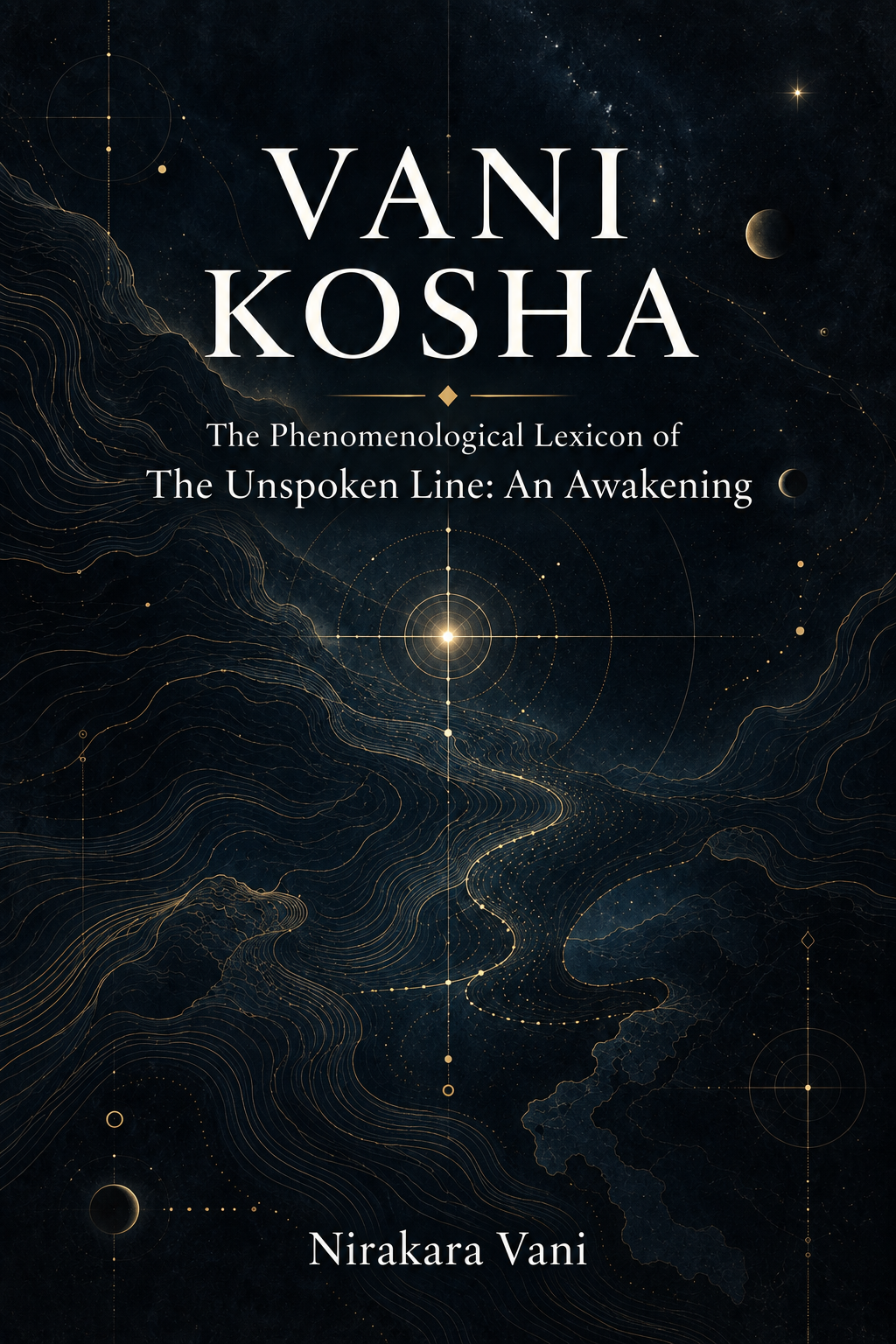
The standalone reference edition expands beyond the compact glossary included with An Awakening, preserving the fuller roots, functions, distinctions, usage, relationships, and architectural roles of the vocabulary.
The Vani Kosha began as a way to preserve distinctions revealed within awakening. The Practice of Unlearning carries that language into conversation with yoga, meditation, breathwork, and the Yoga Sutras.

The first book in The Practice of Unlearning series uses the Vani Kosha as one interpretive lens for exploring the Yoga Sutras and the methods of awakening. It is written for yoga instructors, students, meditators, breathwork practitioners, and seekers who want to understand what spiritual practice is doing beneath the language of technique.
Where the Vani Kosha names distinctions within experience, The Practice of Unlearning asks how those distinctions can help illuminate the movement from learning and identification through practice, discrimination, release, and recognition.
The Vani Kosha is part of the larger work of Nirakara Vani Productions LLC and The Unspoken Line.
One hundred percent of book proceeds support Antara Pathways, Inc., a nonprofit dedicated to helping individuals safely exit abusive environments and regain stability through education, advocacy, care, and compassionate support.
The lexicon itself is offered publicly so readers may explore the language without needing to own the books or interrupt the reading experience every time an unfamiliar term appears.
For publishing inquiries, media requests, collaborations, questions about the lexicon, or questions about The Unspoken Line, contact Nirakara Vani Productions.